Close Board Fencing in Dawlish
Close board fencing for Dawlish gardens
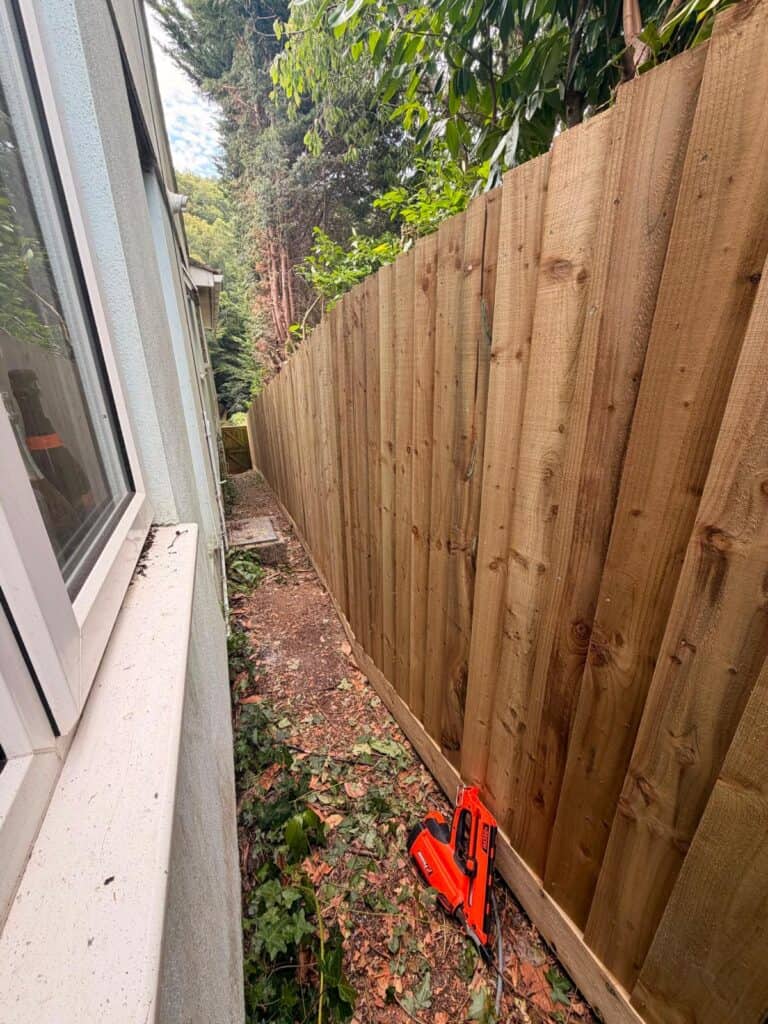
Dawlish is our home town, so we know what its gardens ask of a fence. Plots climb away from the Strand in steps, back gardens on Barton Hill and the roads above Exeter Road drop a storey from one end to the other, and anything facing the sea takes a battering every winter. Close board copes with all of that better than most fences, because every board is fixed by hand onto rails that can follow the ground rather than forcing it into flat panels.
What the ground is like here
Most of the town sits on red sandstone and breccia, the same rock as the cliffs along the sea wall. Near the surface it often breaks up into a sticky red clay with stones through it, and in places the post hole hits solid rock within a couple of feet. We dig each hole and see what’s there before deciding how deep the post goes and how much concrete it needs, rather than using one depth for the whole run. Where rock stops the auger, posts are set into a broken out socket so they still sit firm.
Wind, salt and slope
- Seaward gardens in Dawlish and up towards Holcombe get salt laden south easterlies, so we use pressure treated timber and galvanised or stainless fixings that won’t bleed rust down the boards
- On long, exposed runs we shorten the bay width so each post carries less of the load
- Gravel boards at the foot keep the feather edge off the damp red soil, and can be swapped later without touching the fence
- On sloping plots the rails are stepped or raked to suit the garden, and the boards are trimmed to keep a clean top line
Typical Dawlish jobs
- Replacing a tired panel fence on a terraced back garden where access is through the house
- Screening a garden from a busy road or footpath
- A new boundary on one of the newer homes around Dawlish Warren and the edge of town
- Rebuilding a run that came down in a winter storm
What separates a good Dawlish fence from a quick one
- Post holes: a run dug to one fixed depth takes no notice of what the ground is doing. Checking each hole matters here, where soft clay can sit a few feet along from hard rock.
- Rail joints: rails that simply butt up against a post can work loose. Letting them into the post, or fixing them with proper brackets, keeps every board in line for longer.
- Boards at the bottom: feather edge resting on the soil soaks up water from below. A clear gap above the gravel board costs nothing and keeps the end grain out of the wet.
- The neighbour’s side: a good job looks finished from next door too. Clean lines and a tidy boundary save an awkward conversation later.
Dawlish, street by street
Close to the centre, around the Lawn and the roads beside Dawlish Water, plots are level but walled in, with the older boundaries rarely running straight. Up Stockton Hill and along Elm Grove Road and around Oak Park Villas, a garden can have a sharp change of level across its width, so the fence may need to hold back soil as well as give you privacy, and that changes the way we build its base. Out on the Warren side, gardens tend to be newer, flatter and more open to the weather.
Nobody here needs telling what the sea can do. In February 2014 it took the railway line out along the front. A garden fence won’t face anything like that, but the same winter winds reach well up the hill, and a long run of solid boards catches all of it. That’s why we look at exposure on every visit rather than treating the fence as a straight copy of the last one. You can see how one local job turned out in our write up of new timber fencing and gates in Dawlish.
How we build it, start to finish
We start by walking the boundary together and marking out where each post will go, then agree what stays and what goes. Old fencing is taken down first. Posts go in next, with the holes dug and judged one by one, and the concrete is left to set properly before any weight goes on. Rails come after that, followed by gravel boards, and finally the feather edge, lapped and fixed one board at a time. Offcuts and old timber leave with us, and we’ll walk the finished run with you before we pack up.
Why boards move in the first summer
Feather edge is cut with one thick edge and one thin one, and each board is lapped over its neighbour. Wood loses a little width as it gives up moisture, so a run put up in a damp Devon winter will look a touch different by July. That’s what the overlap is there for, as it hides the movement without leaving you a line of slots to look through. Fine cracks near a board end and a little colour change are normal. A board that’s gone loose or a gap you could post a letter through is not, and that’s worth a closer look.
A fence where a hedge used to be
We’re often asked about a boundary where an old conifer hedge or a row of shrubs has finally gone. That ground behaves differently. Old stumps sit right where a post wants to go, the soil can be dry and full of dead root, and it may settle for a few years as all that rots away. Grinding out stumps along the line, or moving the posts to miss them, usually works better than battling a hole through it. It’s also worth asking whether the hedge marked the actual boundary, because hedges wander as they grow and a new fence fixes a line for years to come.
Capping and counter rails, or leave it plain?
- Plain top: the simplest look, and fine in a sheltered garden where the board tops dry off quickly after rain.
- Capping rail: a strip of timber along the top that covers the end grain, which is where feather edge takes on water first. It’s a modest detail that does a useful job on the rainy side of a hill.
- Counter rail: a thin rail fixed against the boards just under the capping, tidying the line and adding a more finished look from the road.
- Post caps: on timber posts, they keep rain off the top of the post, which helps along with a shaped top.
Decisions worth making before the visit
Four questions tend to come up on site, and it’s easier if you’ve thought about them already. How high do you want it, measured against something real, like your own eye level on the patio? Where does a gate need to be, and how wide, given what you bring through it, whether that’s a wheelbarrow, a mower or a bike? Is there anything along the line that you’d like to keep, like a favourite shrub or an old stone gatepost? And have you spoken with next door? On a town plot, those few minutes over the wall often make the whole job go more smoothly.
Close board fencing in Dawlish: questions
Can you get a fence into a terraced garden with no side access?
Yes. Feather edge boards, rails and posts are all carried through in manageable lengths, which is one reason close board suits Dawlish terraces better than full panels. We protect floors and hallways on the way through.
My garden is on a steep slope. Will the fence look stepped?
It doesn’t have to. Because the boards are fitted one at a time, we can rake the rails to follow the slope so the top runs smoothly, or step it if you prefer level sections. We’ll show you both on the day.
How long should a close board fence last this close to the sea?
Built with treated timber, gravel boards and the right fixings, a close board fence near the coast should give many years of service. The posts usually decide its life, which is why we spend the time on the holes.
Do I need permission for a new fence?
Most back garden fences up to two metres need no planning permission. Fences next to a road, and homes in the Dawlish conservation area or listed buildings, can have tighter rules, so check with Teignbridge District Council if you’re unsure.
Can you put up a fence on top of a retaining wall?
Sometimes, but a wall holding back soil isn’t always built to take the extra load from a fence in high winds. We’ll look at its condition, and if we’re not happy we’ll suggest setting the posts behind it or doing something different.
Our road is steep with hardly any parking. Will that hold things up?
Not usually. Plenty of Dawlish streets are like that, and we plan the deliveries and the carrying around them. Tell us about any permit bays or narrow turns when you enquire, so we can plan for them.
Roughly how many days will a Dawlish close board job take?
It depends on the length, the ground and how far everything has to be carried. You’ll get a realistic idea once we’ve seen it, and we’ll say so if anything turns up that changes that.
Does close board help with road noise?
It can take the edge off, especially where it’s solid right down to the ground and blocks your view of the traffic. Don’t expect silence, though. Sound travels over the top and around the ends, so beside a busy road like the A379 it helps rather than solves. Thick planting in front can make it feel quieter still.
Can I paint or stain it straight away?
It’s better to wait for the timber to dry out, as damp or freshly treated wood doesn’t take colour evenly. Follow the guidance on your chosen product, and try it on a single board first. Remember both faces, if you and next door have agreed on a colour, since a fence stained on one side only can weather unevenly.
Can a gate be built to match?
Yes. Boards from the same batch on a braced frame can make a gate blend into the run, and a matching top line helps. Heavier gates need a stronger hanging post than the fence around them, so tell us early if you want one. Our garden fencing page has more on how the work goes.
If you’re in Dawlish, Holcombe, Dawlish Warren or Cockwood and want a close board fence looked at, send us your enquiry with the rough length and a photo or two of the boundary. We’ll come and walk it with you. For other styles see close board fencing across Devon, fence panels or our main Dawlish fencing page.
Weighing up something other than full close board? In Dawlish we also fit ready made panels, hit and miss boarding that lets the sea breeze through, and modern slatted screens.
Other fencing work in Dawlish
Not quite what you need? In Dawlish we also do fence panels, hit and miss fencing, slatted fencing, composite fencing, chain link fencing, trellis, post and rail fencing, picket fencing, garden gates, driveway gates and fence repairs. Everything we do in the town is on our fencing in Dawlish page, and if the job is over in Teignmouth, see close board fencing in Teignmouth.