Post and Rail Fencing in Dawlish
Post and rail fencing in Dawlish
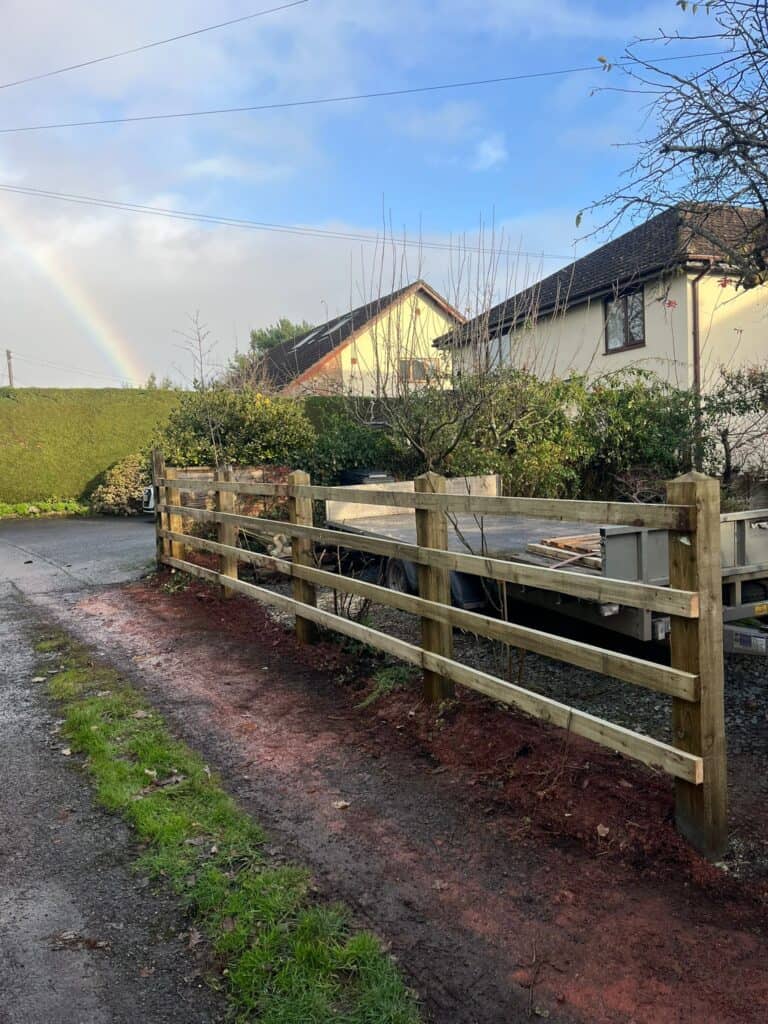
Head inland from the seafront and Dawlish soon turns into steep fields, small paddocks and long driveways climbing the valleys behind the town. That’s where post and rail earns its place. It marks out a field or the edge of a lawn without blocking the view down to the sea, it lets the wind straight through instead of fighting it, and with a bit of netting along the bottom it’ll hold a pony, a few sheep or the family dog.
Who asks us for it round here
- Owners of a field or two who keep horses or ponies
- Smallholders who need a line between grazing and the garden
- Houses with a long drive that want the edge marked without a solid wall of timber
- Holiday lets and parks that want a tidy, open boundary
- Anyone replacing an old rail fence that’s leaning or rotted at the posts
The ground decides how the posts go in
The soil behind Dawlish is mostly the heavy red stuff the cliffs are made of. In summer it bakes hard, and through the winter it holds water like a sponge, which is exactly when a short post starts to rock. Lower down near the streams the field edges stay wet for months. So the first thing we do on a visit is push a bar into the line in a few places and see what we’re dealing with.
Where the ground lets us, we drive the posts, because a driven post sits in undisturbed soil and grips it far better than one dropped into a dug hole. On the stonier hillsides where a post won’t drive cleanly, we dig, set it deeper than you’d think and pack it hard in layers. Either way the corners and gate posts get the most attention, as they take the pull of the whole run.
Rails, netting and horses
Two rails is often enough for marking a boundary or the edge of a drive. For horses we normally go to three, with the rails fixed on the side the animals are kept so a horse leaning on them pushes against the post rather than popping the nails. Joints are staggered so one post never holds every rail end in the line.
If you need it to hold smaller animals, we add stock netting along the lower rails, stapled tight and held a little clear of the grass to stop it rotting. Horses that crib or chew can strip a top rail in a season, so where that’s likely we’ll suggest an offset electric line on stand-off brackets to keep them off it.
Slopes and steep fields
Plenty of the fields around Dawlish fall away hard. Rather than letting rails run at odd angles, we follow the lie of the land so the rails stay parallel to the ground and there are no big gaps underneath on the dips where a lamb or a dog can get through. On the really steep bits, shorter bays keep everything rigid.
Worth settling before anyone walks the field
- What lives there now, and what might later: a line built for one quiet cob can fall short if you take on sheep or a youngster next spring.
- How machines and trailers get in: think about the turn from the lane as well as the gate itself. A horsebox or a topper behind a quad needs more swing than you’d guess from the gap.
- Where the water comes from: a pipe to a trough often runs close to the boundary, and nobody remembers quite where. Old field drains and buried cables are worth asking about too.
- Whose line it is: deeds, a word with the neighbouring landowner, and any old posts in the hedge bank can all help before a new run goes up.
Timber that spends its life in wet ground
Most of a post’s trouble happens in the short band just above and below the soil, where air and water meet. For that reason, ask whether the posts are treated for permanent ground contact, which is usually described as Use Class 4. A rail stays drier, but every saw cut opens up fresh wood, so end grain should get a brush of preservative rather than being left bare. Half round rails look softer on a lawn edge or a drive. Square sawn ones tend to look crisper in a working paddock. Neither will outlast a badly set post.
Up the valley or down by the Warren
Two fields a few miles apart can ask for quite different work. Up towards Ashcombe the worry tends to be how sharply it drops and the runoff after a heavy night. Along the bottom of the valley, close to Dawlish Water, a corner can stay soft well into spring, so we’d want to see it in wet weather if we can, or at least hear what it does then. Nearer Dawlish Warren you may find lighter, sandier ground, which is easy to work but gives a post less to hold on to. That’s why a price for one paddock doesn’t transfer neatly to the next.
Living with the line once it’s up
A walk round after a gale, and again in spring, catches most problems while they’re small. Watch out for rails sprung at the joints, staples lifting from netting and any post that moves when you lean on it. Keep grass and brambles off the bottom rail so it can dry after rain. If horses graze the field, check along the fence for ragwort, and be wary of what hangs over from next door, since yew and some garden clippings are dangerous to them. Those are good questions for your vet, who knows your animals.
Questions people ask us
Should my posts be driven or concreted?
For post and rail we’d rather drive or tamp posts in than concrete them. Concrete round a timber post in wet clay tends to trap water against the wood and rot it from the base. Gate posts on a heavy gate are the exception, and we’ll talk you through it on site.
How many rails do I need for ponies?
Three is the usual answer, with the top rail at a height they can’t easily step over or lean across. For small ponies or foals we’d add netting low down too.
Can you put a gate in the same run?
Yes, and it’s better done together so the hanging post is set properly from the start. Have a look at our gates and access page for the kinds of field and entrance gates we fit.
My old rail fence is leaning. Can you save it?
Sometimes. If the rails are sound and only a few posts have gone at the base, we can replace those posts and refix the rails. Where the majority have gone soft, a new run is usually the better spend, and we’ll tell you honestly which it is. Our fence repairs page covers the repair side.
Is permission needed for a fence round a field?
Usually not for an ordinary field fence, though height limits apply, particularly beside a highway, and rules can differ on protected land or close to a listed building. If you’re unsure, ask Teignbridge’s planning team before you commit. A public footpath across the field also needs to stay open.
How wide should a field gate be?
It depends on what comes through it. A walk-through for people and a led horse can be quite narrow, whereas a tractor or a trailer needs a good deal more, and a lane with a tight turn adds to that. Work from the widest thing you’d ever bring in, then allow room to spare.
Will post and rail keep rabbits or deer out of my garden?
Not on its own. It marks the line and holds larger stock, but rabbits walk straight through and deer can clear it. Rabbits call for fine mesh dug into the ground, and deer call for a much taller fence. Tell us what’s eating the plants, and that shapes what we’d suggest.
You’ll find more on the different rail and netting options on our main post and rail fencing page, and the other work we do in and around the town on fencing in Dawlish. When you’re ready, get in touch with the rough length of the line and what you’re keeping in or out, and one of us will walk the line with you and talk it through.
Other fencing work in Dawlish
Not quite what you need? In Dawlish we also do close board fencing, fence panels, hit and miss fencing, slatted fencing, composite fencing, chain link fencing, trellis, picket fencing, garden gates, driveway gates and fence repairs. Everything we do in the town is on our fencing in Dawlish page, and if the job is over in Teignmouth, see post and rail fencing in Teignmouth.